Job hunting in 2021, I couldn’t tell which companies shared my values. Did hiring managers feel the same gap? I interviewed both sides of hiring, then pitched HayStak, a conversational AI that matches candidates on culture fit, not keywords.
RoleI ran this project solo, from interviews to concept to pitch deck.
ProblemJob seekers couldn't tell where they'd fit, and employers couldn't screen for fit until several interview rounds in.
OutcomeA conversational matching concept, shaped by interviews on both sides of hiring.
TimelineDecember 2021
ToolsNotion, Figma, Pitch
Problem
Job Hunting Felt Like a Numbers Game. There Had to Be a Better Way.
In late 2021 I was finishing my computer science degree and looking for my first job. My career center’s advice was to apply to at least 50. It felt like a numbers game.
Finding roles that meant something to me was the hard part. Advanced searches, like mental health plus technology, didn’t return what I expected. When I found companies I liked through Google, they often weren’t hiring.
Worse yet, when I did find a company that stood out to me it was difficult to signal to them my interest and alignment with their mission. While my resume was competitive with my peers, to hiring managers and automated resume screeners, it was indistinguishable from someone playing the LinkedIn numbers game. There was no way to show how much I cared.
Even then, I couldn’t get a real sense of a company’s culture. Reviews don’t say who wrote them. Small companies barely have any, and big companies vary team to team.
Thesis
Hiring managers want people who share their mission, not just their keywords. But passion only shows up several interviews in.
Research
I Tested My Assumption with the People Who Hire
From my point of view, the process felt broken, but I was only one side of the system. Surely companies and hiring managers would want only the most passionate and mission aligned applicants too, but did they really? Or was this a poor assumption?
So while the spark for this project came from my own lived frustrations, I needed to hear from others on both sides of the system. So I wrote out some questions and got to interviewing.
P1, an IT manager who hires developers at a large multinational company
P2, a former HR director with 13 years leading talent teams
P3, an engineering manager at a small industrial firm with no HR department
P4 and P5, recruiters at a remote finance company of nearly 800 people
P6, a university career counselor
Peer job seekers, in informal conversations
While I asked a variety of questions tailored to each interviewee’s expertise, I led with the goal of answering the crucial question: “In hiring, which is more important: competence or culture fit?”
Bad Hires Are Rarely a Skills Problem
Three of the five hiring-side participants said their bad hires came down to culture, attitude or work ethic. P1 said it’s “usually not a technical issue, more personal.” P2 estimated that “9 / 10 times a bad hire is due to a mismatch in culture.” Screening for skills is the easy part and most applicants that a human actually views meet the baseline competency requirements. Screening for character often takes several interview rounds.
P2, former HR director, on what matters most
"It's easy to screen for competency. It's hard to screen for culture."
P3, engineering manager, on his hiring process
"If you can better match people with characteristics that you [the recruiter] want, this job gets so much easier."
So I made values and attitude the thing to match on, instead of resume keywords.
Candidates Burn Out Before They Ever Talk to a Person
Job seekers described applying to 50 to 100 jobs and never hearing back. One peer, a highly capable coder with an unconventional resume, applied to “too many jobs to count.” He heard back from 4. Another told me, “I just don’t even care anymore when they don’t reach out to me, I kinda just expect it at this point.” Re-entering the same information into every portal made it worse.
The central tension is thus: recruiters fear that if it is too easy to apply they will get inundated with a ton of low quality applicants (see LinkedIn easy-apply) so they impose artificial barriers and hoops for candidates to jump through to even get their foot in the door (why oh why won’t workday save my resume so I don’t have to manually retype my information out for every job I apply to through them). This is a minor annoyance that job seekers just have to deal with in the best case, but high value applicants especially feel disrespected by processes that don’t value their time and will find ways around them or simply not waste their time with them.
A peer job seeker, on application portals
"If a company wants me to retype my information for them I straight up won't apply anymore."
A peer job seeker, on career direction
"I would go in and talk to a career counselor but I have absolutely no idea where to even begin. I feel like I will just end up wasting both of our time."
P6, the career counselor, saw the same thing from her side. The job search is “overwhelming without a plan.” And much of her job was helping students remain disciplined and consistent in their efforts, stressing how much success is correlated with simply applying to more jobs.
Good Candidates Disappear Fast, but Judging Fit Takes Time
P4 and P5 described a candidate market, made bigger by remote work: “People have so many opportunities because it is remote.” P2 called it a “war on talent,” with more openings than candidates.
A recruiter at a remote finance company, on the market
"A good candidate has a very short shelf life before they get scooped up. It's certainly a candidate market."
Judging fit is slow, though. P1 said 45-minute interviews often aren’t long enough to get a feel for someone. But long interviewing processes, while necessary, left more opportunities for their best prospects to fall through the cracks.
So the assistant would handle early fit screening, and people could get to the real conversation faster.
Recruiters Wanted More Human Contact, Not More Applicants
P2, the HR leader, acknowledged that cover letters often didn’t get read despite being required in many cases. He said networking is the best way in, because “if you can make some human connection it is usually better.” And while cover letters attempted to simulate this, they often fell flat and recruiters didn’t have the time to waste on a poor heuristic.
P4 and P5, recruiters at the same company, both wished they had more time for post-hire interviews like 90 day check-ins.
A recruiter, on what they wish they had time for
"Employee engagement stuff in turn helps us with recruitment. Having more conversations with employees past the recruitment stage would be beneficial."
So the goal was to establish human contact as early as possible while offering recruiters more ways to engage with their successful hires as they continued to grow within their company.
Both Sides Were Missing the Same Signal
From both sides the system seemed to promote the strategy of quantity over quality, but what hiring managers wanted most was quality applicants that care. And job seekers wanted the opportunity to interview with companies that actually excited them, feeling that if they could just make it to the interview stage their passion would help carry them through to securing the job.
Employers can’t easily screen for character. Candidates can’t easily show it, or see it in a company before they apply.
Concept
Match People on Values, Then Get Them Talking
The concept, HayStak, is a conversational assistant that would “match job seekers with employers based on personal values, goals, and attitude so employers can build the best possible teams.” The name came from the idea behind it: “Instead of trying to find the needle in the haystack, build a better haystack.”
A candidate answers 3 to 5 questions about their goals, values, and life outside work. It should feel as natural as talking to a career counselor.
A company’s current successful employees answer the same questions.
The assistant compares answers and recommends 1 to 2 well-matched jobs a day, each with a one-line reason, like “I think you will like this job because the company mission closely matches your personal mission.”
Each job has Job, Company and Culture tabs. The Culture tab shows current employees’ answers to the same questions, and the assistant can help submit the application.
Over time it learns preferences, and can suggest career directions the candidate hadn’t considered.
It connects candidates with successful employees early, so people talk sooner.
Scroll sideways to see all 3 screens
1. Answer questions
2. Get matches
3. Apply
Answer a few questions, get matched with a reason for each, then apply with Hannah's help. Mockups from the pitch deck, company names changed.
Draft questions included “What energizes you?”, “What is a problem that you would like to contribute to solving?” and “How do you stave off burnout?” These questions are designed to get to the core of how you work and why you care, which are key factors in team alignment and cohesion.
On each job’s Culture tab, the company’s own employees answer the same questions the candidate did. Reading them should feel like meeting the team before the interview.
Culture tab
The questions lean on Google’s research into its own teams, known as Project Aristotle. It found that who is on a team matters less than how the team works together. Psychological safety, meaning and impact topped the list, and none of them shows up on a resume.
Each Choice Traces Back to Something I Heard
1
In the concept · Volume
1 to 2 matched jobs a day, not an inbox of alerts
Heard in research
Job seekers applied to 50 to 100 jobs and never heard back
2
In the concept · Tone
A conversation that guides like a counselor, not a form
Heard in research
The search is "overwhelming without a plan"
3
In the concept · People
Humans stay in the loop. The match starts a conversation.
Heard in research
Human connection beats cover letters
4
In the concept · Support
Support for managing applications and tough rejections
Heard in research
Burnout came up again and again
I capped matches “so it’s manageable.” By month three, a handful of relevant jobs would replace 30+ alerts. The assistant suggests jobs and people to reach out to, and doesn’t replace recruiters. For rejections, I drew on positive psychology research to reduce stress.
Hannah checks in between matches. She nudges when saved jobs pile up, and when a role closes she breaks the news and points to what’s still open.
Check-ins
While the nature of conversational AI is highly customizable I intentionally designed the core experience to be light and enjoyable. The prototype purposefully highlights quality over quantity, as my research suggests this paradigm to be more pleasant and effective for both parties.
However, it’s worth noting this is a hypothesis still to be tested as in all of my research I could not find any popular tools that actually promoted a quality-first workflow.
I recognize that this approach is best suited to a specific type of job seeker that has a long runway and therefore less urgency to find a job right now. The brevity encourages a passive and enjoyable habit of seeking out new opportunities which fits well with this user, but is likely insufficient for job seekers on a more rushed timeframe.
If I were to continue this project I would establish passive job seekers as the primary user and optimize the experience for their needs. While users on a more aggressive time frame might find they need to combine this tool with other products to reach their goals, it is important that the app doesn’t try to serve too many user groups with competing goals initially as that would dilute its core value and distract from creating a product that one group can love. Feedback from the other group would be acknowledged and collected for future growth opportunities after the core product has been established.
Feedback
They'd Pay for It. But Only If Both Sides Show up.
I showed mockups to P2, P3 and P6. I asked if it would bring better applicants, whether they’d pay, and what worried them. While initial reception was positive, I recognize there were some limitations to my methodology used due to time constraints. Further testing would be beneficial to more rigorously challenge my assumptions.
P3 liked that current employees answer the same questions. He already has candidates talk with his engineers without the boss in the room. He said that if it raised his hiring success rate 15%, he’d pay as much as a recruiter, about one month’s salary. That was his own estimate. He also liked that it “eliminates bias.”
P2 saw a second use. The same questions could help companies “stay connected with your people” as an engagement tool. He also said asking the right questions is critical, and to limit it to 3 to 5.
Then he named the catch. Job boards are a crowded market, and the winners are the ones with the most people on them. Matching only works if enough candidates and companies join.
Mockup board
The mockups I walked them through, from the first chat to applying.
Opportunity
Start Where Job Seekers Need the Most Help
I’d launch with salaried roles that need a four-year degree, targeting college students as my ideal job seeker. They often have weak networks, lean on job boards and events, and need guidance. Career centers are underused, and P6 saw a role for the assistant: “It would be really beneficial if the AI could direct students to resources until they can find time to come in.”
Career centers would pay, and companies opt in. I’d start with tech companies because they have “been differentiating themselves through culture for years” and need the most in-demand talent. For companies, fewer and better-matched applicants mean faster responses, and “being on the platform shows you take your culture seriously.”
The timing looked right. Online recruiting was about a $29.3B market in 2021, forecast to reach about $47.3B by 2028. Good candidates were getting hired fast, and remote work gave them more options while making culture harder to read from outside. No major platform matched on culture.
From the pitch
"Companies will go where the best talent is… if we create the ultimate candidate experience companies will follow."
Later, it could feed into an applicant tracking system and run “stay”-style check-ins with current employees. I priced it like a job board, per applicant, but never finished the market sizing.
Next Steps
What I'd Prove Before Building Anything
This project was completed over the course of just 2 weeks and as a result I was not able to verify many of the assumptions implicit in this concept’s design. To de-risk the project, I’d do some hands-on prototyping with real users to verify what the least amount of data is required to make effective matches.
The pitch closed on three steps: refine the matchmaking questions, hand-test the matching algorithm, then build a software MVP.
Identify Additional Inputs to Bootstrap Initial Company Profiles
The proposed mechanism for matching companies and job seekers hinges on quality responses from both parties. Two-sided markets can be difficult to maintain and launch as the efficacy scales with participation from the other side, creating a chicken-and-egg problem in the early stages of building the network.
How I would de-risk it: I’d look for more readily available information about companies that currently exists, things such as Glassdoor reviews, mission statements, and company values that can be easily scraped online. I would tune the algorithm to use this data in lieu of any employee responses and take a hybrid approach until sufficient employee data is received.
Determine What to Ask
The core assumption that this product hinges on is that you can tell enough about the way someone works from 3 to 5 questions to actually produce reliable and unique matches. But I did not administer any tests that verifiably prove this claim.
How I would de-risk it: Run a questionnaire with one team’s strongest employees to determine the key 3 to 5 questions to ask. I’d check where their answers lined up and where they differed to determine what actually matters for team cohesion.
Project Aristotle’s five team dynamics would give me a first set of questions to test.
More Case Studies
Ready for Another Adventure?
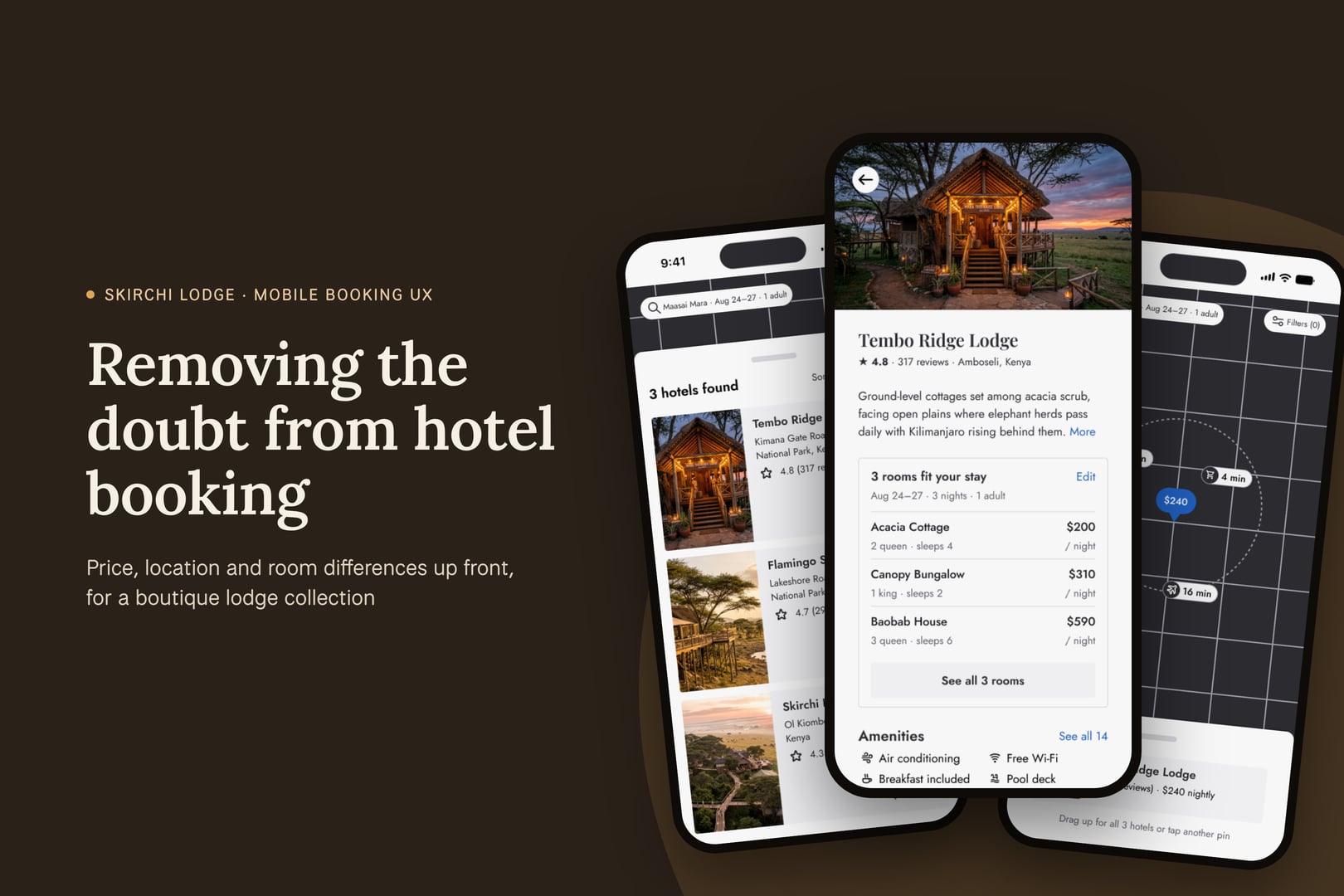
Removing Doubt From Mobile Hotel Booking
This project was part of a UX Design Institute assignment to design the booking experience for a hotel aggregator website. I first analyzed competitor websites to find gaps in the market before designing and iterating on my own prototype.
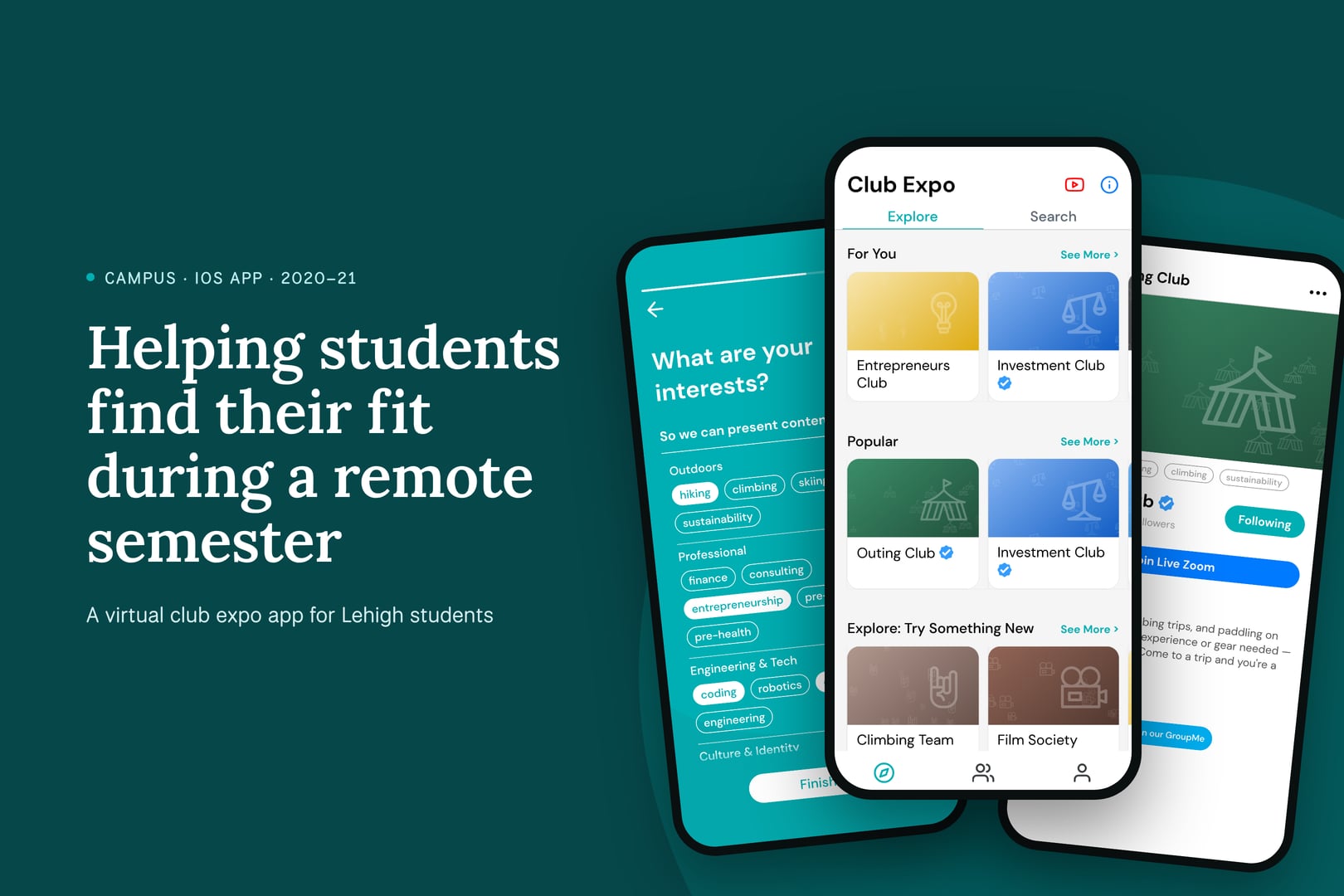
Co-founded in College Pandemic, Campus set out to fix how students discovered clubs and community, a problem COVID made urgent overnight. I led research and design and built roughly half the frontend, eventually winning a competitive bid to run the university's official virtual club fair.